Today's
EarthStation1.com 15% Off Commemorative Memorial Title: The
Western Tradition TV Series DVD, MP4 Video Download, USB Drive
Today, December 17, 2025
December 17: Saturnalia: -- December 17,
497 BC: Rome: Ancient Rome: Roman Festivals: Roman Holidays:
Saturnalia: -- The first Saturnalia festival was celebrated in
ancient Rome. Saturnalia was an ancient Roman festival in honour
of the god Saturn, held on December 17 of the Julian calendar and
later expanded with festivities through to December 23. The
holiday was celebrated with a sacrifice at the Temple of Saturn,
in the Roman Forum, and a public banquet, followed by private
gift-giving, continual partying, and a carnival atmosphere that
overturned Roman social norms: gambling was permitted, and masters
provided table service for their slaves. The poet Catullus called
it "the best of days". It was the Roman equivalent to
the earlier Greek holiday of Kronia, which was celebrated during
the Attic month of Hekatombaion in late midsummer. The popularity
of Saturnalia continued into the 3rd and 4th centuries AD, and as
the Roman Empire came under Christian rule, many of its customs
were recast into or influenced the seasonal celebrations
surrounding Christmas and the New Year. On Sale @ 15% Off Discount
Till Midnight PT!
https://store.earthstation1.com/the-western-tradition-dvd-set-all-52-shows-13-d5213.html
Today's
EarthStation1.com 15% Off Commemorative Memorial Title: The
Machine That Changed The World: The Computer DVD MP4 Download
Today, December 17, 2025
December 17: National Device Appreciation
Day: -- An opportunity to appreciate the devices that help us lead
our lives, and take steps to protect those that are most important
to you. The best, most effective way to protect all of the items
that contribute joy in your life is to properly insure them,
ensuring that they can continue to positively impact your life for
years to come, no matter what unexpected problems may arise. This
year, National Device Appreciation Day is sponsored by the
Traverse, a fully mobile insurance platform for Texans that
provides customizable coverage in under a minute for your new or
old mobile phones, laptops, bicycles, etc., quickly, easily, and
inexpensively, with coverage from as little as $1 per month.
Traverse has sponsored National Device Appreciation Day in order
to get the word out about properly insuring your most important
belongings in a way that makes the most sense for your lifestyle.
Traverse is backed by Travelers, a trusted insurance company that
has been in the business for over 165 years. Insurance is often
the last thing you think about until you absolutely need it. But
it can make the difference between weathering a turn of bad luck
and not. Homeowners and renters insurance are important
protections against various hazards like fire and theft, but the
expense and administrative effort of insuring an entire home's
worth of items isn't always the most convenient for everyone,
which is what Traverse solves. But where does our modern concept
of insurance come from? It turns out, insurance has been around in
various forms for millennia. Merchants in the ancient city of
Rhodes could pay what was known as "the general average"
which covered them against shipping losses when goods were shipped
collectively. The ancient Greeks and Romans had "maritime
loans" which insured against similar issues and it was
commonplace (though sometimes controversial) to provide similar
types of coverage during the medieval period. However, we can
trace modern forms of insurance, including property insurance, to
the European Enlightenment period of the 17th century. The
earliest known types of insurance available to the public guarded
against fire damage (no surprise there) in the city of Hamburg,
Germany in 1676. But property insurance as we know it today has
its roots in one of history's most iconic events, the Great Fire
of London. In the aftermath of that great fire which destroyed
some 13,000 residences, London economists created the "Insurance
Office for Houses" which protected residents from damage
caused by fires. Today, there are many different types of
insurance that protect persons and property from a whole host of
inclement events such as fire, weather, sickness, death, etc.
While it isn't always the most exciting aspect of modern life, it
remains more critical than ever as belongings become more and more
essential to our lives and often, more expensive. On Sale @ 15%
Off Discount Till Midnight PT!
https://store.earthstation1.com/the-machine-that-changed-the-world-the-computer-dvd-mp4-downloa4.html
Today's
EarthStation1.com 15% Off Commemorative Memorial Title: Aviation
History Films Collection DVD MP4 Video Download
Today, December 17, 2025
December 17: Wright Brothers Day: --
December 17, 1903: Aviation: The History Of Aviation: Aviation In
The Pioneer Era: The Wright Brothers: Maiden Flights:-- The
Orville and Wilbur Wright make the first controlled powered,
heavier-than-air flight in the Wright Flyer at Kill Devil Hills,
four miles south of Kitty Hawk, North Carolinam, marking the
beginning of The Pioneer Era Of Aviation. They made four flights,
the longest lasting about a minute. Three days prior, on December
14, 1903, the Wright Brothers made their first attempt to fly with
the Wright Flyer at Kill Devil Hills, but failed. The Wright Flyer
(often retrospectively referred to as Flyer I or 1903 Flyer) was
the first successful heavier-than-air powered aircraft. Designed
and built by the Wright Brothers, they flew it four times on
December 17, 1903, near Kill Devil Hills, about four miles (six
kilometers) south of Kitty Hawk, North Carolina. Today, the
airplane is exhibited in the National Air and Space Museum in
Washington D.C. The U.S. Smithsonian Institution describes the
aircraft as "the first powered, heavier-than-air machine to
achieve controlled, sustained flight with a pilot aboard."
The flight of the Wright Flyer marks the beginning of the "pioneer
era" of aviation. Kill Devil Hills is a town in Dare County,
North Carolina. The population was 6,683 at the 2010 census, up
from 5,897 in 2000. It is the most populous settlement in both
Dare County and on the Outer Banks of North Carolina. The Kill
Devil Hills Micropolitan Statistical Area is part of the larger
Virginia Beach-Norfolk, VA-NC Combined Statistical Area. The town
is home to the site of the Wright Brothers' first controlled,
powered airplane flights on December 17, 1903, chosen for its good
winds. The town was commemorated by the Wright Brothers National
Memorial, which was dedicated in 1932. At the time of the Wright
Flyer flights the town of Kill Devil Hills did not exist, and it
did not receive its municipal charter until 1953. Kitty Hawk,
popularly noted as the site of the famous flights, is
approximately four miles (6 km) to the north, and was the nearest
settlement at the time of the famous flight. On Sale @ 15% Off
Discount Till Midnight PT!
https://store.earthstation1.com/aviation-history-films-2-dual-layer-dvd-se2.html
Today's
EarthStation1.com 15% Off Commemorative Memorial Title: Civil
Props: The Douglas DC-3 DVD, MP4 Video Download, USB Drive
Today, December 17, 2025
December 17, 1935: Aviation: The History
Of Aviation: The History Of Civil Aviation: Maiden Flights: -- On
the 32nd anniversary of the Wright Brothers' first flight at Kitty
Hawk, the DST (Douglas Sleeper Transport), the prototype of the
Douglas DC-3 makes its maiden flight with Douglas chief test pilot
Carl Cover at the controls. The Douglas DC-3 is a propeller-driven
airliner which had a lasting effect on the airline industry in the
1930s/1940s and World War II. It was developed as a larger,
improved 14-bed sleeper version of the Douglas DC-2. It is a
low-wing metal monoplane with conventional landing gear, powered
by two radial piston engines of 1,000-1,200 hp (750-890 kW).
(Although most DC-3s flying today use Pratt & Whitney R-1830
Twin Wasp engines, many DC-3s built for civil service originally
had the Wright R-1820 Cyclone.) The DC-3 has a cruise speed of 207
mph (333 km/h), a capacity of 21 to 32 passengers or 6,000 lbs
(2,700 kg) of cargo, and a range of 1,500 mi (2,400 km), and can
operate from short runways. The DC-3 had many exceptional
qualities compared to previous aircraft. It was fast, had a good
range, was more reliable, and carried passengers in greater
comfort. Before the war, it pioneered many air travel routes. It
was able to cross the continental US from New York to Los Angeles
in 18 hours and with only 3 stops. It is one of the first
airliners that could profitably carry only passengers without
relying on mail subsidies. Following the war, the airliner market
was flooded with surplus transport aircraft and the DC-3 was no
longer competitive due to its size and speed. It was made obsolete
on main routes by more advanced types such as the Douglas DC-4 and
Lockheed Constellation, but the design proved adaptable and useful
on less glamorous routes. Civil DC-3 production ended in 1942 at
607 aircraft. Military versions, including the C-47 Skytrain (the
Dakota in British RAF service), and Soviet- and Japanese-built
versions, brought total production to over 16,000. Many continue
to see service in a variety of niche roles: 2,000 DC-3s and
military derivatives were estimated to be still flying in 2013; a
2017 article put the number at that time at more than 300. On Sale
@ 15% Off Discount Till Midnight PT!
https://store.earthstation1.com/civil-props-the-douglas-dc3-dv3.html
Today's
EarthStation1.com 15% Off Commemorative Memorial Title:
Unidentified Flying Objects 1956 Movie/Bonus Al Chop Interview MP4
DVD
Today, December 17, 2025
December 17, 1969: Unidentified Flying
Objects (UFOs, Unidentified Anomalous Phenomenon, UAPs): Ufology:
Project Bluebook (The Real Project Bluebook): -- On the 66th
anniversary of the Wright Brothers' first flight at Kitty Hawk,
the United States Air Force publicly states that it has "closed"
the Project Blue Book study of UFOs, although it continues to
operate in secret under the same name. Project Blue Book was one
of a series of systematic studies of unidentified flying objects
(UFOs) conducted by the United States Air Force (USAF). It started
in 1952, the third study of its kind, following projects Sign
(1947) and Grudge (1949). A termination order was given for the
study in December 1969, and all activity under its auspices
officially ceased on January 19th, 1970. Project Blue Book had two
goals: 1) To determine if UFOs were a threat to national security;
and 2) To scientifically analyze UFO-related data. Thousands of
UFO reports were collected, analyzed, and filed. As a result of
the Condon Report (1968), which controversially concluded there
was nothing anomalous about UFOs despite cases it admitted
supported possible extraterrestrial explanations, and a review of
the report by the National Academy of Sciences, Project Blue Book
was announced to have been terminated in December 1969. The Air
Force supplies the following public summary of its investigations:
No UFO reported, investigated, and evaluated by the Air Force was
ever an indication of threat to our national security; There was
no evidence submitted to or discovered by the Air Force that
sightings categorized as "unidentified" represented
technological developments or principles beyond the range of
modern scientific knowledge; and there was no evidence indicating
that sightings categorized as "unidentified" were
extraterrestrial vehicles. By the time Project Blue Book ended, it
had collected 12,618 UFO reports, and concluded that most of them
were misidentifications of natural phenomena (clouds, stars, etc.)
or conventional aircraft. According to the National Reconnaissance
Office a number of the reports could be explained by flights of
the formerly secret reconnaissance planes U-2 and A-12. A small
percentage of UFO reports were classified as unexplained, even
after stringent analysis. The UFO reports were archived and are
available under the Freedom Of Information Act, but names and
other personal information of all witnesses have been redacted. On
Sale @ 15% Off Discount Till Midnight PT!
https://store.earthstation1.com/unidentified-flying-objects-the-true-story-of-flying-saucers-dvd.html
Today's
EarthStation1.com 15% Off Commemorative Memorial Title: Triumph Of
The West 13 Part TV Documentary Series DVD, Download, USB
Today, December 17, 2025
December 17, 1538: Religion: The History
Of Religion: Abrahamic Religions: Christianity: Roman Catholicism:
The Latin Church (Latin: Ecclesia Latina): Excommunication:
Excommunication In The Catholic Church: The Excommunication Of
Henry VIII: -- Pope Paul III excommunicates Henry VIII Of England.
As a consequence of the extensive campaign against "idolatry"
in England, culminating with the dismantling of the shrine of St.
Thomas Becket at Canterbury, the Pope excommunicated Henry VIII
and issued an interdict (in Catholic canon law, an interdict is a
censure or ban that prohibits persons, groups and/or territories).
In 1540, Henry sanctioned the complete destruction of shrines to
saints. In 1542, England's remaining monasteries were all
dissolved, and their property transferred to the Crown. Abbots and
priors lost their seats in the House of Lords; only archbishops
and bishops remained. Consequently, the Lords Spiritual - as
members of the clergy with seats in the House of Lords were known
- were for the first time outnumbered by the Lords Temporal, or
secular members. On Sale @ 15% Off Discount Till Midnight PT!
https://store.earthstation1.com/triumph-of-the-west-tv-series-5-dual-layer-dvds-all-13-sh513.html
Today's
EarthStation1.com 15% Off Commemorative Memorial Title: American
Revolutionary War Documentaries DVD, Download, USB Drive
Today, December 17, 2025
December 17, 1777: The Age Of
Enlightenment (The Enlightenment, The Age Of Reason): The Age Of
Revolution: The Atlantic Revolutions: The American Enlightenment:
The American Revolution: The Second Continental Congress: The
Articles Of Confederation: -- Following the Second Continental
Congress' approval of the "Articles Of Confederation"
for ratification by the states on November 15, 1777, France
formally recognizes the United States. Though the the Articles Of
Confederation only came into full force once it was ratified by
all 13 states on March 1, 1781, Congress nevertheless began
immediately to operate under the Articles' terms once they
approved the articles. This provided a structure of shared
sovereignty during prosecution of the war, which enable the
international relations and alliances with France and Spain that
the new United States would come to depend on, as it establised a
central government which received those powers which the former
colonies had recognized as belonging to king and parliament. The
Articles Of Confederation and Perpetual Union was an agreement
among the 13 original states of the United States of America that
served as its first constitution. It was approved, after much
debate between July 1776 and November 1777, and sent to the states
for ratification. On Sale @ 15% Off Discount Till Midnight PT!
https://store.earthstation1.com/american-revolutionary-war-dvd-documentaries.html
Today's
EarthStation1.com 15% Off Commemorative Memorial Title: Hitler's
Bomb: The German Nuclear Weapons Program DVD, MP4, USB Drive
Today, December 17, 2025
December 17, 1938: The Interwar Period
(The Aftermath Of World War I, The Interbellum, Between The Wars):
Nuclear Chemistry: Nuclear Physics: German Inventions Of The Nazi
Period: Nuclear Fission: The Discovery Of Nuclear Fission: --
Nuclear fission is discovered by chemists Otto Hahn and Fritz
Strassmann and physicists Lise Meitner and Otto Robert Frisch, a
nuclear reaction or radioactive decay process in which the nucleus
of an atom splits into two or more smaller, lighter nuclei and
often other particles. The fission process often produces gamma
rays and releases a very large amount of energy, even by the
energetic standards of radioactive decay. Scientists already knew
about alpha decay and beta decay, but fission assumed great
importance because the discovery that a nuclear chain reaction was
possible led to the development of nuclear power and nuclear
weapons. Hahn was awarded the 1944 Nobel Prize in Chemistry for
the discovery of nuclear fission. Hahn and Strassmann at the
Kaiser Wilhelm Institute for Chemistry in Berlin bombarded uranium
with slow neutrons and discovered that barium had been produced.
Hahn suggested a bursting of the nucleus, but he was unsure of
what the physical basis for the results were. They reported their
findings by mail to Meitner in Sweden, who a few months earlier
had fled Nazi Germany. Meitner and her nephew Frisch theorised,
and then proved, that the uranium nucleus had been split and
published their findings in Nature. Meitner calculated that the
energy released by each disintegration was approximately 200
megaelectronvolts, and Frisch observed this. By analogy with the
division of biological cells, he named the process "fission".
The discovery came after forty years of investigation into the
nature and properties of radioactivity and radioactive substances.
The discovery of the neutron by James Chadwick in 1932 created a
new means of nuclear transmutation. Enrico Fermi and his
colleagues in Rome studied the results of bombarding uranium with
neutrons, and Fermi concluded that his experiments had created new
elements with 93 and 94 protons, which his group dubbed ausenium
and hesperium. Fermi won the 1938 Nobel Prize in Physics for his
"demonstrations of the existence of new radioactive elements
produced by neutron irradiation, and for his related discovery of
nuclear reactions brought about by slow neutrons". However,
not everyone was convinced by Fermi's analysis of his results. Ida
Noddack suggested that instead of creating a new, heavier element
93, it was conceivable that the nucleus had broken up into large
fragments, and Aristid Von Grosse suggested that what Fermi's
group had found was an isotope of protactinium. This spurred Hahn
and Meitner, the discoverers of the most stable isotope of
protactinium, to conduct a four-year-long investigation into the
process with their colleague Strassmann. After much hard work and
many discoveries, they determined that what they were observing
was fission, and that the new elements that Fermi had found were
fission products. Their work overturned long-held beliefs in
physics and paved the way for the discovery of the real elements
93 (neptunium) and 94 (plutonium), for the discovery of fission in
other elements, and for the determination of the role of the
uranium-235 isotope in that of uranium. Niels Bohr and John
Wheeler reworked the liquid drop model to explain the mechanism of
fission. On Sale @ 15% Off Discount Till Midnight PT!
https://store.earthstation1.com/hitler39s-bomb-the-german-nuclear-weapons-program-dvd-mp4-394.html
Today's
EarthStation1.com 15% Off Commemorative Memorial Title: Pursuit Of
The Graf Spee Battle Of The River Plate DVD MP4 USB Drive
Today, December 17, 2025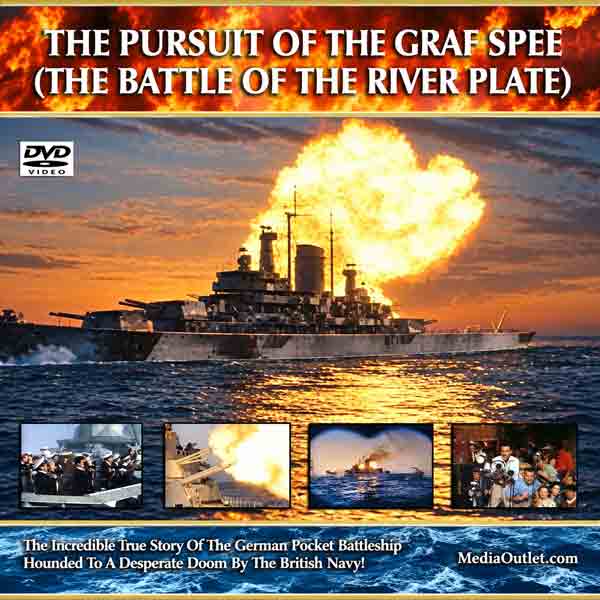
December 17, 1939: The European Civil
War: World War II: The Second European War (The European Theater
Of World War II): The American Theater Of World War II (The
Americas Theater Of World War II): The Battle Of The River Plate:
-- The German pocket battleship Admiral Graf Spee is scuttled by
Captain Hans Langsdorff in the River Plate estuary by The Bay Of
Montevideo outside Montevideo, Uruguay in order to avoid
unnecessary loss of life for no particular military advantage in
battle against a Royal Navy squadron lying in wait for the Graf
Spee to make a break for the Atlantic Ocean, a decision that
infuriated Adolf Hitler.. On December 13, during the Battle Of The
River Plate, Captain Langsdorff of the German Deutschland-class
cruiser (pocket battleship) Admiral Graf Spee engages with Royal
Navy cruisers HMS Exeter, HMS Ajax and HMNZS Achilles. The Battle
Of The River Plate was the first naval battle in the Second World
War and the first one of the Battle of the Atlantic in South
American waters. The German "Panzerschiff" (armored
ship) Admiral Graf Spee, nicknamed a "pocket battleship"
by the British, had cruised into the South Atlantic a fortnight
before the war began, and had been commerce raiding after
receiving appropriate authorization on 26 September 1939. One of
the hunting groups sent by the British Admiralty to search for
Graf Spee, comprising three Royal Navy cruisers, HMS Exeter, Ajax
and Achilles (the last from the New Zealand Division), found and
engaged their quarry off the estuary of the River Plate close to
the coast of Uruguay in South America. In the ensuing battle,
Exeter was severely damaged and forced to retire; Ajax and
Achilles suffered moderate damage. The damage to Admiral Graf
Spee, although not extensive, was critical; her fuel system was
crippled. Ajax and Achilles shadowed the German ship until she
entered the port of Montevideo, the capital city of neutral
Uruguay, to effect urgent repairs. After Graf Spee's captain Hans
Langsdorff was told that his stay could not be extended beyond 72
hours, he scuttled his damaged ship rather than face the
overwhelmingly superior force that the British had led him to
believe was awaiting his departure. Radio newsmen reported live on
its destruction and their reports were broadcast on American
radio. After the scuttling, Langsdorff then shot himself dead with
a pistol while lying upon Graf Spee's battle ensign. On Sale @ 15%
Off Discount Till Midnight PT!
https://store.earthstation1.com/the-pursuit-of-the-graf-spee-the-battle-of-the-river-plate-dvd.html
Today's
EarthStation1.com 15% Off Commemorative Memorial Title: The Battle
Of The Bulge Documentaries Collection DVD MP4 Download USB
Today, December 17, 2025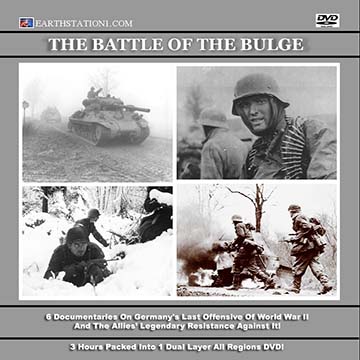
December 17, 1944: The European Civil
War: World War II: The Second European War (The European Theater
Of World War II): The Western Front Of World War II: The Battle Of
The Bulge (The Ardennes Offensive) (German: Unternehmen Wacht Am
Rhein, "Operation Watch On The Rhine"): The Malmedy
Massacre: -- 84 American 285th Field Artillery Observation
Battalion POWs are shot dead by Waffen-SS Kampfgruppe Joachim
Peiper. Peiper was convicted of war crimes committed in Belgium,
sentenced to death and later had his sentence commuted to time
served after being imprisoned for almost 12 years. He was also
accused of war crimes in Italy, but Italian and German courts
controversially concluded that there was insufficient evidence to
warrant prosecution. After his release from prison, Peiper worked
for both Porsche and Volkswagen, before moving to France, where he
translated books from English to German under the nom de plume
"Rainer Buschmann". Peiper was murdered in France in
July 1976. Residing in France since 1972, Peiper led a quiet and
discreet life; however, he continued to use his given name. In
1974, he was identified by a former Communist resistance member of
the region who issued a report for the French Communist Party. In
1976, a Communist historian, investigating the Gestapo archives,
found the Peiper file. On 21 June 1976, tracts denouncing his
presence were distributed in Traves. A day later, an article in
the left-wing publication L'Humanite revealed Peiper's presence in
Traves and he received threats that his house would be burned down
and his dogs killed. On receipt of these threats, Peiper, who
remained in Traves, sent his family back to Germany. During the
night of 13/14 July 1976 (Bastille Day), Peiper's home was
attacked. In the ruin, Peiper's charred corpse was found together
with a .22 caliber rifle and a pistol. The perpetrators were never
identified, though a group calling itself The Avengers claimed
responsibility for his death; the charred remains of the house
briefly became a visitor attraction. The circumstances of his
death have led to allegations that it was faked. On Sale @ 15% Off
Discount Till Midnight PT!
https://store.earthstation1.com/the-battle-of-the-bulge-dvd-world-war-ii-documentaries.html
Today's
EarthStation1.com 15% Off Commemorative Memorial Title:
Autobiographies: The Enigma Of Bobby Bittman SCTV MP4 Download Or
DVD
Today, December 17, 2025
December 17, 1946: #BOTD: #HBD! Eugene
Levy, Canadian actor, comedian, producer, director, musician,
writer and screenwriter, is #born to a Jewish family in downtown
Hamilton, Ontario, Canada. He is the only actor to have appeared
in all eight of the American Pie films, in his role as Noah
Levenstein. He often plays nerdy, unconventional figures, with his
humour often deriving from his excessive explanations of matters
and the way in which he deals with sticky situations. Levy is a
regular collaborator of actor-director Christopher Guest,
appearing in and co-writing four of his films, commencing with
Waiting for Guffman (1997). Levy received the Governor General's
Performing Arts Award, Canada's highest honour in the performing
arts, in 2008. He was appointed to the Order of Canada on June 30,
2011. He is an alumnus of both the Second City, Toronto
improvisational comedy enterprise and the sketch comedy series
Second City Television, also known as SCTV. On Sale @ 15% Off
Discount Till Midnight PT!
https://store.earthstation1.com/autobiographies-the-enigma-of-bobby-bittman-dvd-mp4-download-us4.html
Today's
EarthStation1.com 15% Off Commemorative Memorial Title: Korea: The
Unknown War TV Korean War Series DVD, Download, USB Drive
Today, December 17, 2025
December 17, 1950: Korea: The History Of
Korea: The Aftermath Of World War II: The Cold War: The Cold War
In Asia: The Korean Conflict: The Cold War (1947-1953): The Cold
War In Asia: The Korean War: -- Kim Il-Sung is deprived of the
right of command of Korean People's Army (KPA) by China, who
thereafter take de facto military leadership of communist forces
in the conflict. China justified its entry into the war by
claiming it was a response to "American aggression in the
guise of the UN". Later, however, the Chinese claimed that US
bombers had violated PRC national airspace on three separate
occasions and attacked Chinese targets before China intervened,
which raids have since been substatiated. The day prior, December
16, 1950, U.S. President Harry S. Truman declares a state of
National Emergency after Chinese troops entered the fight in
support of communist North Korea with his Proclamation 2914,
entitled "Proclaiming The Existence Of A National Emergency,
declaring that the United States' "military, naval, air and
civilian defenses" should be used to fight communism as part
of the Korean War. The first President to issue an emergency
proclamation was Woodrow Wilson on February 5, 1917, in response
to the insufficiency of maritime tonnage during Wordl War I.
Starting with Franklin D. Roosevelt in 1933, presidents asserted
the power to declare emergencies without limiting their scope or
duration, without citing the relevant statutes, and without
congressional oversight. Presidents have continued to use their
emergency authority before and after their being subject to the
provisions of the National Emergencies Act enacted September 14,
1976. On Sale @ 15% Off Discount Till Midnight PT!
https://store.earthstation1.com/korea-the-unknown-war-dvd-complete-6-part-tv-series-3-dis63.html
Today's
EarthStation1.com 15% Off Commemorative Memorial Title: The
Struggles For Poland TV Series + Bonus MP4 Video Download DVD Set
Today, December 17, 2025
December 17, 1970: The Aftermath Of World
War II: The Cold War: Cold War Rebellions: Eastern Block Violent
Revolutions: Anti-Communist Resistance In Poland (1944-1989): The
History Of The Polish People's Republic: Massacres In Poland: The
1970 Polish Protests (Polish: Grudzien 1970, "December
1970"): -- Soldiers fire machine guns at shipyard and other
workers emerging from trains in the city of Gdynia, killing dozens
of people. The 1970 Polish Protests (Polish: Grudzien 1970,
"December 1970") occurred in northern Poland during
December 14-19, 1970. The protests were sparked by a sudden
increase in the prices of food and other everyday items. Strikes
were put down by the Polish People's Army and the Citizen's
Militia, resulting in at least 44 people killed and more than
1,000 wounded. On the evening of December 16, Polish Vice Prime
Minister Stanislaw Kociolek condemned the protesters in a
televised speech, but also called for the workers to get back to
work. However, that night, the shipyard in Gdynia was surrounded
by the police and the military, including tanks. Responding tp the
Vice PM's appeal as he asked them to do proved deadly; in Gdynia,
the soldiers had orders to stop workers returning to work, and on
December 17 fired randomly into the crowd of workers emerging from
their trains; at least 11 of them were killed. Then, in other
parts of Gdynia, people were shot dead while protesting, bringing
the official death toll in Gdynia to 18. The number of the wounded
in Gdynia from these wonton and irresponsible attacks is not
certain. but is estimated to be in the hundreds. The protest
movement then spread to other cities, leading to strikes and
occupations. The government mobilized 5,000 members of special
squads of police and 27,000 soldiers equipped with heavy tanks and
machine guns. According to recent estimates, overall more than
1,000 people were wounded, at least 44 killed, and 3,000 arrested.
Only six people were initially reported dead by the government.
All who died were buried overnight, with only the closest
relatives present or no relatives present at all, in order to
avoid spreading the riots. On Sale @ 15% Off Discount Till
Midnight PT!
https://store.earthstation1.com/the-struggles-for-poland-dvd-set-all-9-shows-5-dis95.html
Today's
EarthStation1.com 15% Off Commemorative Memorial Title: The Rise
And Fall Of Ceausescu Documentary DVD, Download, USB Drive
Today, December 17, 2025
December 17, 1989: The Aftermath Of World
War II: The Cold War: The Cold War (1985-1991) (The End Of The
Cold War): The Dissolution Of The Soviet Union: The Revolutions Of
1989 (The Fall Of Nations, The Autumn Of Nations, The Fall Of
Communism): The Eastern Bloc (The Communist Bloc, The Socialist
Bloc, The Soviet Bloc): The Romanian Revolution (The Christmas
Revolution): -- The Romanian Revolution that began the day prior
in Timisoara, Romania, in response to an attempt by the government
to evict dissident Hungarian pastor Laszlo Tokes on trumped up
charges of inciting ethnic hatred, gains momentum as members of
his ethnic Hungarian congregation surrounded his apartment in a
show of support. Romanian students spontaneously joined the
demonstration, which soon lost nearly all connection to its
initial cause and became a more general anti-government
demonstration, with rioters breaking into the Romanian Communist
Party's District Committee building and attempting to set it on
fire. Regular military forces, police, and the Securitate fired on
demonstrators, killing and injuring men, women, and children. The
revolution which soon spreads throughout the country, ultimately
culminating in the drumhead trial and execution of longtime
Romanian Communist Party (PCR) General Secretary Nicolae Ceausescu
and his wife Elena, and the end of 42 years of Communist rule in
Romania. The Romanian Revolution (Romanian: Revolutia Romana),
also known as The Christmas Revolution (Romanian: Revolutia de
Craciun)), was part of the Revolutions of 1989 that occurred in
several countries around the world. It was the last removal of a
Marxist-Leninist government in a Warsaw Pact country during the
events of 1989, and the only one that violently overthrew a
country's leadership and executed its leader. According to
estimates, over one thousand people died and thousands more were
injured. On Sale @ 15% Off Discount Till Midnight PT!
https://store.earthstation1.com/the-rise-and-fall-of-ceausescu-dvd.html
Today's
EarthStation1.com #OnThisDay Commemorative Memorial Title: Fibber
McGee And Molly Complete Radio Series MP3 DVD, Download, USB
Today, December 17, 2025 December 17: National Maple Syrup Day: --
This viscous yet delicious condiment that is just as versatile as
it is tasty; people enjoy it drizzled over everything: from
pancakes, to eggs, to salads, to barbecue, this sugary substance
has more potential than some give it credit for. On December 17,
pour away! The origins of the production of maple syrup can be
traced back thousands of years to the northeastern region of the
United States. There, it was first gleaned from the abundant maple
tree population by indigenous peoples. While it is uncertain as to
how and why exactly the extraction process first began, it is
inarguable that maple sap became a key ingredient in a variety of
dishes. The arrival of European colonists would allow for the
introduction of maple syrup to the Old World, and their love for
the taste of the arboreal byproduct was matched by their
appreciation for its utility. It was a popular substitute for cane
sugar, as this had to be imported from the West Indies region, and
its ability to exist in both liquid and crystallized form made it
an ideal source for concentrated sugar. The colonists' extraction
methods differed from those of the indigenous peoples, and they
would serve as the foundation for several subsequent iterations
upon the process. Some maple trees may have even seen dozens of
changes to the extraction procedures used upon them, as they can
continue to be tapped for sap for more than 100 years! Today, the
consumption of maple syrup is no longer reserved for chieftains or
special celebratory events. It is not only used across the world,
but production chains have even sprung up in countries like Japan
and South Korea. Canada now produces the vast majority of the
world's maple syrup supply with its total exports valued at more
than 270M USD. It may have happened at the rate of molasses, but
maple syrup is now known (and loved) far beyond the pocket of the
northeast.
https://store.earthstation1.com/fibber-mcgee-and-molly-mp3-dvd-complete-radio-serie3.html
Today's
EarthStation1.com #OnThisDay Commemorative Memorial Title: War
Jets: Duel Over Korea: F-86 Sabre Vs MiG-15 Fagot MP4 Download DVD
Today, December 17, 2025December 17, 1950: Korea: The History Of
Korea: The Aftermath Of World War II: The Cold War: The Cold War
In Asia: The Korean Conflict: The Cold War (1947-1953): The Cold
War In Asia: The Korean War: Air Warfare Of The Korean War: -- On
the 47th anniversary of the Wright Brothers' first flight at Kitty
Hawk, The North American F-86 Sabre flies its first mission over
Korea. Sometimes called the Sabrejet, the North American F-86
Sabre is a transonic jet fighter aircraft. Produced by North
American Aviation, the Sabre is best known as the United States'
first swept wing fighter that could counter the swept-wing Soviet
MiG-15 in high-speed dogfights in the skies of the Korean War
(1950-1953), fighting some of the earliest jet-to-jet battles in
history. Considered one of the best and most important fighter
aircraft in that war, the F-86 is also rated highly in comparison
with fighters of other eras. Although it was developed in the late
1940s and was outdated by the end of the 1950s, the Sabre proved
versatile and adaptable and continued as a front-line fighter in
numerous air forces until the last active operational examples
were retired by the Bolivian Air Force in 1994. Its success led to
an extended production run of more than 7,800 aircraft between
1949 and 1956, in the United States, Japan, and Italy. Variants
were built in Canada and Australia. The Canadair Sabre added
another 1,815 airframes, and the significantly redesigned CAC
Sabre (sometimes known as the Avon Sabre or CAC CA-27), had a
production run of 112. The Sabre is by far the most-produced
Western jet fighter, with total production of all variants at
9,860 units.
https://store.earthstation1.com/war-jets-duel-over-korea-f86-sabre-vs-mig15-fagot-mp4-downloa86154.html
Today's
EarthStation1.com #OnThisDay Commemorative Memorial Title: Outer
Space Films 11 Space Race US vs USSR DVD, Video Download, USB
Today, December 17, 2025December 17, 1957: Rocket Launches: The
History Of Rocketry: The History Of Spaceflight: Intercontinental
Ballistic Missiles (ICBMs): Intercontinental Ballistic Missiles
(ICBMs) Of The United States: Maiden Flights: The Atlas Rocket
Family: The SM-65 Atlas: -- On the 54th anniversary of the Wright
Brothers' first flight at Kitty Hawk, The United States conducts
its first successful test launch of the first Atlas
intercontinental ballistic missile, the Convair X-11/SM-65A
Atlas/Atlas A, the first full-scale prototype of the Atlas
missile, first flying on June 11, 1957 at Cape Canaveral, Florida.
The first successful flight took place on November 28, 1958 with a
SM-65 Atlas, thereby becoming the world's first operational
intercontinental ballistic missile (ICBM) (the earlier Soviet R-7
Semyorka ICBM was the world's first intercontinental ballistic
missile with 28 launches between 1957 and 1961, but was never
deployed operationally), developed by the United States and the
first member of the Atlas rocket family. The SM-65 Atlas was built
for the U.S. Air Force by the Convair Division of General Dynamics
at an assembly plant located in Kearny Mesa, San Diego. Atlas
became operational in October 1959, but was soon made obsolete as
an ICBM by new development, and was retired from this role by
1965. The SM-65 Atlas required long preparation times which made
it unsuitable for a quick launch ICBM. However, this was not a
requirement for planned space launches, and so Atlas-derived
launch vehicles served a long history as space launchers. Even
before its ICBM use ended in 1965, Atlas had placed four Project
Mercury astronauts in orbit and was becoming the foundation for a
family of successful space launch vehicles, most notably Atlas
Agena and Atlas Centaur. The Atlas-Centaur was evolved into the
Atlas II, various models of which were launched 63 times between
1991 and 2004. Mergers led to the acquisition of the Atlas Centaur
line by the United Launch Alliance. There were only six launches
of the succeeding Atlas III, all between 2000 and 2005. Today ULA
supports the larger Atlas V, which combines the Centaur upper
stage with a new booster, with launches planned into the 2020s..
Until 2001, many retired Atlas ICBMs were refurbished and combined
with upper stages to launch satellites. More than 300 Atlas
launches have been conducted from Cape Canaveral Air Force Station
in Florida and 285 from Vandenberg Air Force Base in California.
https://store.earthstation1.com/outer-space-films-11-space-race-us-vs-ussr-d11.html
Today's
EarthStation1.com #OnThisDay Commemorative Memorial Title: The
Secret War Historic WWII TV Series + Bonus Title DVD MP4 USB Drive
Today, December 17, 2025December 17, 1997: #DOTD: #RIP: Reginald
Victor Jones, aka R. V. Jones, British physicist and scientific
military intelligence expert now known as "The Father Of S &
T (Scientific And Technical) Intelligence" (b. September 29,
1911) #dies of a heart attack in Aberdeen, North East Scotland,
aged 86. He is buried in Corgarff Cemetery, Strathdon,
Aberdeenshire, Scotland. His papers are held by Churchill College,
Cambridge. Reginald Victor Jones CH (Order Of The Companions Of
Honour), CB (The Most Honorable Order Of The Bath), CBE (Commander
Of The British Empire), FRS (Fellow Of The Royal Society), FRSE
(Fellow Of The Royal Society Of Edinburgh) was born in Herne Hill,
South London, England. He played a leading role in the defence of
Britain in World War II, particularly with regard to radar, the
invention of chaff anti-radar the breaking of German codes,
monitoring German special weapons and electronic sysems, the Nazi
atomic bomb effort particularly in the area of heavy water
production, and leading what Winston Churchill called "The
Wizard War". Reginald Jones was born in Herne Hill, south
London, on 29 September 1911. He was educated at Alleyn's School,
Dulwich, and Wadham College, Oxford, where he studied Natural
Sciences. In 1932 he graduated with First Class honours in physics
and then, working in the Clarendon Laboratory, completed his DPhil
in 1934. Subsequently, he took up a Skynner Senior Studentship in
Astronomy at Balliol College, Oxford. In 1936 Jones took up the
post at the Royal Aircraft Establishment, Farnborough, a part of
the Air Ministry. Here he worked on the problems associated with
defending Britain from an air attack. In September 1939, the
British decided to assign a scientist to the Intelligence section
of the Air Ministry. No scientist had previously worked for an
intelligence service. Jones quickly rose to become Assistant
Director of Intelligence (Science) there. During the course of the
Second World War he was closely involved with the scientific
assessment of enemy technology, and the development of offensive
and counter-measures technology. He solved a number of tough
Scientific and Technical Intelligence problems during World War
II. He was briefly based at Bletchley Park in September 1939, but
returned to London (Broadway) in November, leaving behind a small
specialized team in Hut 3, who reported any decrypts of scientific
or technology nature to "ADI Science". F. W.
Winterbotham passed Jones the Oslo Report, received in 1939, and
Jones decided that it was genuine, though the three service
ministries regarded it as a "plant" and discarded their
copies: "... in the few dull moments of the War, I used to
look up the Oslo report to see what should be coming along next."
Jones's first job was to study "new German weapons",
real or potential. The first of these was a radio navigation
system which the Germans called Knickebein. This, as Jones soon
determined, was a development of the Lorenz blind landing system
and enabled an aircraft to fly along a chosen heading with useful
accuracy. At Jones's urging, Winston Churchill ordered up an RAF
search aircraft on the night of 21 June 1940, and the aircraft
found the Knickebein radio signals in the frequency range which
Jones had predicted. With this knowledge, the British were able to
build jammers whose effect was to "bend" the Knickebein
beams so that German bombers spent months scattering their bomb
loads over the British countryside. Thus began the "Battle of
the Beams" which lasted throughout much of World War II, with
the Germans developing new radio navigation systems and the
British developing countermeasures to them. Jones frequently had
to battle against entrenched interests in the armed forces, but,
in addition to enjoying Churchill's confidence, had strong support
from, among others, Churchill's scientific advisor F. A. Lindemann
and the Chief of the Air Staff Sir Charles Portal. As early as
1937, Jones had suggested that a piece of metal foil falling
through the air might create radar echoes. He, together with Joan
Curran, were later instrumental in the deployment of "Window":
strips of metal foil, cut to a length appropriate to the radar's
wavelength, and dropped in bundles from aircraft, which then
appeared on enemy radar screens as "false bombers", and
was first used during Operation Gomorrah, the deadly bombing of
Hamburg that created one of the largest firestorms of World War
II. This technology is now known as chaff and contrary to the
popular belief, was also known to the Germans at the time. Both
parties were reluctant to use it out of fear that their enemy
would do the same: This delayed its deployment for almost two
years. Jones also served as a V-2 rocket expert on the Cabinet
Defence Committee (Operations) and headed a German long range
weapons targeting deception under the Double-Cross System. In 1946
Jones was appointed to the Chair of Natural Philosophy at the
University of Aberdeen, which he held until his retirement in
1981. He did not want to stay in Intelligence under the proposed
postwar reorganisation. During his time at Aberdeen, much of his
attention was devoted to improving the sensitivity of scientific
instruments such as seismometers, capacitance micrometers,
microbarographs and optical levers. His book Instruments and
Experiences details much of his later work in some depth and can
act as a reference work on fine mechanism design. Jones was
appointed Commander of the Order of the British Empire (CBE) in
1942, for the planning of a raid on Bruneval to capture German
radar equipment (Churchill had proposed that Jones should be
appointed a Companion of the Order of the Bath (CB) but the head
of the Civil Service Sir Horace Wilson threatened to resign as
Jones was only a lowly Scientific Officer, and the CBE was a
compromise; he was subsequently appointed CB in 1946; and
Companion of Honour (CH) in the 1994 Queen's Birthday Honours. He
was elected Fellow of the Royal Society in 1965, and received an
honorary DSc from the University of Aberdeen in 1996. Jones
married Vera Cain in 1940 - they had two daughters and a son. His
autobiography, Most Secret War: British Scientific Intelligence
1939-1945, formed the basis, pre-publication, of the BBC One TV
documentary series "The Secret War", first aired on
January 5, 1977 and narrated by William Woollard, in which Jones
was the principal interviewee. The historian A. J. P. Taylor
described Most Secret War as "the most fascinating book on
the Second World War that I have ever read" and, more
generally, it has acquired almost classic status. In 1981, Jones
became a founding member of the World Cultural Council. The same
year he delivered the Royal Institution Christmas Lectures on From
Magna Carta to Microchip. In 1993 he was the first recipient of
the R. V. Jones Intelligence Award, which the CIA created in his
honour.
https://store.earthstation1.com/the-secret-war-wwii-weaponry-tv-series-all-7-episodes-2-dv72.html
Today's
EarthStation1.com #OnThisDay Commemorative Memorial Title: The
Story Of Civilization: Will & Ariel Durant DVD, MP3 Download,
USB
Today, December 17, 2025December 17, 1273: #DOTD: #RIP: Rumi,
Persian poet, faqih (jurist of Islamic law), Islamic scholar,
theologian, philosopher and Sufi mystic originally from Greater
Khorasan in Greater Iran (b. September 30, 1207) #dies in Konya in
the Sultanate of Rum in south-central Turkey, aged 66. His death
was mourned by the diverse community of Konya, with local
Christians and Jews joining the crowd that converged to bid
farewell as his body was carried through the city. Rumi's body was
interred beside that of his father, and a splendid shrine, the
Yesil Turbe (Turkish: Green Tomb, today the Mevlana Museum), was
erected over his place of burial. His epitaph reads: "When we
are dead, seek not our tomb in the earth, but find it in the
hearts of men." Georgian Queen Gurcu Hatun was a close friend
of Rumi. She was the one who sponsored the construction of his
tomb in Konya. The 13th century Mevlana Mausoleum, with its
mosque, dance hall, schools and living quarters for dervishes,
remains a destination of pilgrimage to this day, and is probably
the most popular pilgrimage site to be regularly visited by
adherents of every major religion. Born Jalal ad-Din Muhammad Rumi
to native Persian-speaking parents, Rumi was originally from the
Balkh, in present-day Afghanistan, in either in Wakhsh, a village
on the Vakhsh River in present-day Tajikistan, or in the city of
Balkh, in present-day Afghanistan. Also known as Jalal ad-Din
Muhammad Balkhi, Mevlana/Mawlana ("our master"),
Mevlevi/Mawlawi ("my master"), Rumi's influence
transcends national borders and ethnic divisions: Iranians,
Tajiks, Turks, Greeks, Pashtuns, other Central Asian Muslims, and
the Muslims of the Indian subcontinent have greatly appreciated
his spiritual legacy for the past seven centuries. His poems have
been widely translated into many of the world's languages and
transposed into various formats. Rumi has been described as the
"most popular poet" and the "best selling poet"
in the United States.
https://store.earthstation1.com/story-of-civilization-will-amp-ariel-durant-mp3-dvd-11-audiobo311.html
Today's
EarthStation1.com #OnThisDay Commemorative Memorial Title:
Millhouse: A White Comedy (1971) Richard Nixon Farce MP4 Download
DVD
Today, December 17, 2025December 17, 2005: #DOTD: #RIP: Jack
Anderson, American journalist and author, newspaper columnist,
syndicated by United Features Syndicate, considered one of the
founders of modern investigative journalism (b. October 19, 1922)
#dies of complications from Parkinson's disease in Bethesda,
Maryland, aged 83. He is buried at Ferguson Family Cemetery in
Poages Mill, Virginia. Jack Anderson was born Jack Northman
Anderson in Long Beach, California. Anderson won the 1972 Pulitzer
Prize for National Reporting for his investigation on secret U.S.
policy decision-making between the United States and Pakistan
during the Indo-Pakistani War of 1971. In addition to his
newspaper career, Anderson also had a national radio show on the
Mutual Broadcasting System, acted as Washington bureau chief of
Parade magazine, and was a commentator on ABC-TV's Good Morning
America for nine years. Among the exposes Anderson reported were
the Nixon administration's investigation and harassment of John
Lennon during its fight to deport Lennon; the continuing
activities of fugitive Nazi officials in South America; and the
savings and loan crisis. He revealed the history of a CIA plot to
assassinate Fidel Castro and was credited for breaking the story
of the Iran-Contra Affair under President Reagan. He said that the
scoop was "spiked" because the story had become too
close to President Ronald Reagan.
https://store.earthstation1.com/millhouse-a-white-comedy-dvd-1971-richard-nixon-documen1971.html
Today's
EarthStation1.com #OnThisDay Commemorative Memorial Title:
Beethoven: The Composer As Hero DVD, Video Download, USB Flash
Drive
Today, December 17, 2025December 17, 1770: Baptisms: -- Ludwig
van Beethoven, German pianist and composer, possible Freemason
(evidence for which is good but circumstantial) (December 16, 1770
(?) - March 26, 1827) is baptised in the Catholic Parish of St.
Remigius in Bonn, Germany. There is no authentic record of the
date of his birth, but the custom in the region at the time was to
carry out baptism within 24 hours of birth, and the registry of
his baptism survives at the parish. There is a consensus (with
which Beethoven himself agreed) that his birth date was December
16, but there is no documentary proof of this. Ludwig van
Beethoven was in fact born in Bonn, Germany. He created powerful,
emotional music and is widely consider the greatest orchestral
composer who ever lived. He suffered from hearing loss before he
was 30 and by the time of his last (Ninth) symphony, he was
completely deaf. In 1824, he conducted the Ninth Symphony at its
world premier in Vienna although he was unable to hear either the
orchestra or the applause. In all, he composed nine symphonies, 32
piano sonatas, five piano concerti, 17 string quartets, ten
sonatas for violin and piano, the opera Fidelio, the Mass in C
Major, Missa Solemnis, and other chamber music.
https://store.earthstation1.com/beethoven-the-composer-as-hero-dvd.html
Today's
EarthStation1.com #OnThisDay Commemorative Memorial Title: The
Romantic Spirit TV Series DVD, Video Download, USB Flash Drive
Today, December 17, 2025December 17, 1865: Premieres: -- Franz
Schubert's landmark Symphony No. 8, commonly known as the
Unfinished Symphony (German: Unvollendete) is first performed in
Vienna, conducted by Johann Von Herbeck, and was received with
great enthusiasm by the audience. Symphony No. 8 in B minor, D 759
(sometimes renumbered as Symphony No. 7, in accordance with the
revised Deutsch catalogue and the Neue Schubert-Ausgabe), is a
musical composition that Schubert started in 1822 but left with
only two movements - though he lived for another six years. A
scherzo (a short composition, sometimes a movement from a larger
work such as a symphony or a sonata), nearly completed in piano
score but with only two pages orchestrated, also survives.
Schubert's Symphony No. 8 is sometimes called the first Romantic
symphony, due to its emphasis on expressive melody, vivid harmony,
and creative combinations of orchestral tone color; for this
reason, part of the symphony is used as the theme music of the
1983 television documentary series on the history of the Romantic
Movement, "The Romantic Spirit".
https://store.earthstation1.com/the-romantic-spirit-tv-series-all-14-episodes-5-dual-layer-d145.html
Today's
EarthStation1.com #OnThisDay Commemorative Memorial Title: The Nat
King Cole Show 1956-1957 TV Series MP4 Video Download DVD Set
Today, December 17, 2025December 17, 1957: Aesthetics: Performing
Arts: Finales: American Television Finales: -- The Nat 'King' Cole
Show airs for the last time. The show debuted on NBC on November
5, 1956. The variety program was one of the first hosted by an
African American. The program started at a length of
fifteen-minutes but was increased to a half-hour in July 1957.
Although Rheingold Beer was a regional sponsor of the show, a
national sponsor was never found, and companies such as Max Factor
vociferously opposed sponsoring it. As a result, the show was in
trouble financially, despite efforts by NBC, Harry Belafonte, Tony
Bennett, Ella Fitzgerald, Eartha Kitt, Frankie Laine, Peggy Lee,
and Mel Torme to spark sufficient interest in the show to attract
sponsors. Failing this, Cole decided to end the program;
commenting on the lack of sponsorship, he said shortly after its
demise, "Madison Avenue is afraid of the dark.".
https://store.earthstation1.com/the-nat-king-cole-show-dvd-set-2-discs-classic-music-t2.html
Today's
EarthStation1.com #OnThisDay Commemorative Memorial Title: TV
Music & Dance Shows #8 American Action DVD, MP4, USB Flash
Drive
Today, December 17, 2025December 17, 1939: #BOTD: #HBD! Eddie
Kendricks, African American singer and songwriter, co-founder of
the Motown singing group The Temptations and one of their lead
singers from 1960 until 1971 (d. October 5, 1992) is #born Edward
James Kendrick in Union Springs, Alabama. Noted for his
distinctive falsetto singing style, Eddie Kendricks was the lead
voice on such famous songs as "The Way You Do the Things You
Do", "Get Ready", and "Just My Imagination
(Running Away with Me)". As a solo artist, Kendricks recorded
several hits of his own during the 1970s, including the number-one
singles "Keep On Truckin'" and "Boogie Down".
In late 1991, Kendricks underwent surgery to have one of his lungs
removed in the hope of preventing the spread of cancer. He
believed the disease was caused by his 30 years of smoking. He
continued to tour through the summer of 1992, when he fell ill
again and was hospitalized and died of lung cancer at Baptist
Medical Center-Princeton in Birmingham, Alabama at age 52. He was
survived by his three children: Parris, Aika, and Paul Kendricks
(named after Paul Williams). A funeral service was held at the
First Baptist Church in Ensley, Alabama. He is buried in Elmwood
Cemetery, Birmingham. Friends and fans paid tribute to Kendricks
at four concerts, held at the Strand in Los Angeles, on October 16
and October 17, 1992. Performers including Bobby Womack, Chaka
Khan, Mary Wilson, and Vesta Willams sang Temptations songs, as
well as some of their own.
https://store.earthstation1.com/classic-tv-music-amp-dance-shows-8-where-american-action-is-dv8.html
Today's
EarthStation1.com #OnThisDay Commemorative Memorial Title: DJ
Madness! 1950s-60s-70s Radio Shows DVD, MP3 Download, USB Drive
Today, December 17, 2025December 17, 1999: #DOTD: #RIP: Grover
Washington Jr., African American jazz-funk and soul-jazz
saxophonist, singer, songwriter, and record producer (b. December
12, 1943) #dies in Manhattan, New York aged 56 of a massive heart
attack suffered while waiting in the green room after performing
four songs for The Saturday Early Show, at CBS Studios in New York
City. He was taken to St. Luke's-Roosevelt Hospital, where he was
pronounced dead at about 7:30 pm. He is interred at West Laurel
Hill Cemetery in Bala Cynwyd, Pennsylvania. Grover Washington Jr.
was born in Buffalo, New York. Along with Wes Montgomery and
George Benson, he is considered by many to be one of the founders
of the smooth jazz genre. He wrote some of his material and later
became an arranger and producer. Throughout the 1970s and 1980s,
Washington made some of the genre's most memorable hits, including
"Mister Magic", "Reed Seed", "Black
Frost", "Winelight", "Inner City Blues",
"Let it Flow (For 'Dr. J')" and "The Best is Yet to
Come". In addition, he performed very frequently with other
artists, including Bill Withers on "Just the Two of Us",
Patti LaBelle on "The Best Is Yet to Come" and Phyllis
Hyman on "A Sacred Kind of Love". He is also remembered
for his take on the Dave Brubeck classic "Take Five",
and for his 1996 version of "Soulful Strut".
https://store.earthstation1.com/dj-radio-airchecks-mp3-dvd-1950s60s70s-dis319506070.html
Today's
EarthStation1.com #OnThisDay Commemorative Memorial Title: TV
Music & Dance Shows #15 Ready Steady Go Vol II DVD MP4 Flash
Drive
Today, December 17, 2025December 17, 2006: #DOTD: #RIP: Denis
Payton, saxophonist, guitarist and harmonica player in the rock
and roll band the Dave Clark Five (b. August 11, 1943) #dies in
Bournemouth, England of cancer after a long illness at the age of
63. His remains were cremated, and the ashes given to his partner
of sixteen years, Lindsay. In October 2006, two months prior to
his death, the Dave Clark Five was nominated for induction into
The Rock And Roll Hall Of Fame. Payton told Dave Clark, who
visited him on his sickbed: "I know I won't be around, but it
was an amazing part of my life that I am very proud of." The
Dave Clark Five was inducted into the Hall of Fame on March 10,
2008. Surviving members of the band Dave Clark, Lenny Davidson and
Rick Huxley were present; Mike Smith and Denis Payton were
honoured with the band posthumously. Born Denis Archibald West
Payton in Walthamstow, Essex (now part of East London), he learned
as a child to play guitar, saxophone and other wind instruments.
As a teenager he played in a jazz band while studying to become an
electrician. Through his band membership, he made acquaintance
with members of other bands. Being a competent musician, he was
often invited to join them, and he moved from one band to another.
One of his acquaintances was Dave Clark, the leader of the group
'Dave Clark Five with Stan Saxon'. When Saxon, who played
saxophone and occasionally sang, departed in 1962 along with
second saxophonist Jim Spencer, the group was renamed the 'Dave
Clark Five', and Denis Payton became his successor. In its early
years, Dave Clark's group primarily played instrumental music.
While Stan Saxon sometimes sang, after his departure pianist Mike
Smith, who later exchanged his piano for an electronic organ,
provided the vocals. The group changed its repertoire from jazz
and dance music to pop music. After Payton's arrival, the band's
line-up comprised Dave Clark (drums), Mike Smith (vocals and
organ), Lenny Davidson (guitar), Rick Huxley (bass guitar) and
Denis Payton (saxophone). This line-up remained unchanged for the
next eight years. Apart from saxophone, Payton occasionally played
guitar and harmonica (he played the harmonica solo on the group's
hit single "Catch Us If You Can" and played the
sousaphone on "The Red Balloon"), and sang background
vocals. Payton also co-wrote over two dozen songs with Dave Clark
for the group, two of which he sang lead vocals: "I Miss You"
and "Man in the Pin Striped Suit". The Dave Clark Five
scored many big hits, both in the United Kingdom and the United
States. Apart from "Catch Us If You Can", other million
sellers were "Glad All Over", "Bits and Pieces"
and "Over and Over". Payton enjoyed his finest hour when
the great American jazz saxophonist Stan Getz, one of Payton's
music idols, asked Payton for his autograph after attending a Dave
Clark Five concert. In 1970, the group disbanded. Payton became an
estate agent in Bournemouth, but he continued to play in a few
amateur bands in his spare time.
https://store.earthstation1.com/classic-tv-music-amp-dance-shows-15-ready-steady-go-ii-d15.html
Today's
EarthStation1.com #OnThisDay Commemorative Memorial Title: It Was
Twenty Years Ago Today: 1967 & Sgt. Pepper DVD MP4 USB Drive
Today, December 17, 2025December 17, 1942: #BOTD: #HBD! Paul
Butterfield, American blues singer, harmonica player and
bandleader (d. May 4, 1987) is #born Paul Vaughn Butterfield in
Chicago and raised in the city's Hyde Park neighborhood. After
early training as a classical flautist, he developed an interest
in blues harmonica. He explored the blues scene in his native
Chicago, where he met Muddy Waters and other blues greats, who
provided encouragement and opportunities for him to join in jam
sessions. He soon began performing with fellow blues enthusiasts
Nick Gravenites and Elvin Bishop. In 1963, he formed the Paul
Butterfield Blues Band, which recorded several successful albums
and was popular on the late-1960s concert and festival circuit,
with performances at the Fillmore West, in San Francisco; the
Fillmore East, in New York City; the Monterey Pop Festival; and
Woodstock. The band was known for combining electric Chicago blues
with a rock urgency and for their pioneering jazz fusion
performances and recordings. After the breakup of the group in
1971, Butterfield continued to tour and record with the band Paul
Butterfield's Better Days, with his mentor Muddy Waters, and with
members of the roots-rock group the Band. While still recording
and performing, Butterfield died in 1987 at age 44 of an
accidental drug overdose. Music critics have acknowledged his
development of an original approach that places him among the
best-known blues harp players. In 2006, he was inducted into the
Blues Hall of Fame. Butterfield and the early members of the Paul
Butterfield Blues Band were inducted into The Rock And Roll Hall
Of Fame in 2015. Both panels noted his harmonica skills and his
contributions to bringing blues music to a younger and broader
audience. Paul Butterfield died at his apartment in the North
Hollywood district of Los Angeles. His remains were cremated; the
final disposition of his ashes are not publicly disclosed other
than that they were given to his family or friend(s). An autopsy
by the county coroner concluded that he was the victim of an
accidental drug overdose, with "significant levels of
morphine (heroin), ... codeine, the tranquilizer Librium and a
trace of alcohol." Beginning in 1980, Paul Butterfield
underwent several surgical procedures to relieve his peritonitis,
a serious and painful inflammation of the intestines. Although he
was strongly opposed to heroin as a bandleader, his eventual
addiction to it was likely the result of trying to relieve the
pain of his disease. The financial strain of supporting his drug
habit was bankrupting him, and the accidental overdose death of
his friend and one-time musical partner Mike Bloomfield, and the
death by heart attack of his manager Albert Grossman, had shaken
him. By the time of his death, Paul Butterfield was out of the
commercial mainstream. Although for some, he was very much the
blues man, Maria Muldaur commented "he had the whole
sensibility and musicality and approach down pat ... He just went
for it and took it all in, and he embodied the essence of what the
blues was all about. Unfortunately, he lived that way a little too
much."
https://store.earthstation1.com/it-was-20-years-ago-today-1967-and-sgt-pepp201967.html
Today's
EarthStation1.com #OnThisDay Commemorative Memorial Title: Frank
Zappa Documentaries MP4 Video Download DVD
Today, December 17, 2025December 17, 2010: #DOTD: #RIP: Captain
Beefheart (Don Van Vliet), American singer-songwriter, musician,
and artist (b. January 15, 1941) #dies on a Friday at a hospital
in Arcata, California of complications from multiple sclerosis,
from which he had for many years. Tom Waits and his
colloborator/wife Kathleen Brennan commented on his death,
praising him: "Wondrous, secret ... and profound, he was a
diviner of the highest order." Dweezil Zappa dedicated the
song "Willie The Pimp" to Beefheart at the "Zappa
Plays Zappa" show at the Beacon Theatre in New York City on
the day of his death, while Jeff Bridges exclaimed "Rest in
peace, Captain Beefheart!" at the conclusion of the December
18, 2010, episode of NBC's Saturday Night Live. He is buried at
Trinidad Lighthouse Lost & Buried at Sea Memorials in
Trinidad, California. Captain Beefheart was born Don Glen Vliet in
Glendale, California. Captain Beefheart conducted a rotating
ensemble called the Magic Band, with whom he recorded 13 studio
albums between 1964 and 1982. His music blended elements of blues,
free jazz, rock, and the avant-garde with idiosyncratic rhythms,
absurdist wordplay, and his wide vocal range. Known for his
enigmatic persona, Beefheart frequently constructed myths about
his life and was known to exercise an almost dictatorial control
over his supporting musicians. Although he achieved little
commercial success, he sustained a cult following as a "highly
significant" and "incalculable" influence on an
array of new wave, punk, and experimental rock artists. An
artistic prodigy in his childhood, Van Vliet developed an eclectic
musical taste during his teen years in Lancaster, California, and
formed "a mutually useful but volatile" friendship with
musician Frank Zappa, with whom he sporadically competed and
collaborated. He began performing with his Captain Beefheart
persona in 1964 and joined the original Magic Band line-up,
initiated by Alexis Snouffer, the same year. The group released
their debut album Safe as Milk in 1967 on Buddah Records. After
being dropped by two consecutive record labels they signed to
Zappa's Straight Records, where they released 1969's Trout Mask
Replica; the album would later rank 58th in Rolling Stone
magazine's 2003 list of the 500 greatest albums of all time. In
1974, frustrated by lack of commercial success, he pursued a more
conventional rock sound, but the ensuing albums were critically
panned; this move, combined with not having been paid for a
European tour, and years of enduring Beefheart's abusive behavior,
led the entire band to quit. Beefheart eventually formed a new
Magic Band with a group of younger musicians and regained critical
approval through three final albums: Shiny Beast (1978), Doc at
the Radar Station (1980) and Ice Cream for Crow (1982). Van Vliet
made few public appearances after his retirement from music in
1982. He pursued a career in art, an interest that originated in
his childhood talent for sculpture, and a venture which proved to
be his most financially secure. His expressionist paintings and
drawings command high prices, and have been exhibited in art
galleries and museums across the world.
https://store.earthstation1.com/frank-zappa-documentaries-mp4-video-download-dv4.html
Today's
EarthStation1.com #OnThisDay Commemorative Memorial Title: The
Frogmen 1951 Richard Widmark Dana Andrews DVD, MP4, USB Drive
Today, December 17, 2025December 17, 1992: #DOTD: #RIP: Dana
Andrews, American film actor who became a major star in what is
now known as film noir (b. January 1, 1909) #dies of congestive
heart failure and pneumonia in Los Alamitos, California, aged 83.
His remains were cremated, and the ashes given to his widow Mary
Todd. He was born Carver Dana Andrews on a farmstead near Collins
in southern Mississippi. A leading man during the 1940s, he
continued acting in less prestigious roles and character parts
into the 1980s. He is best known for his portrayal of obsessed
police detective Mark McPherson in the noir Laura (1944) and his
critically acclaimed performance as World War II veteran Fred
Derry in The Best Years of Our Lives (1946).
https://store.earthstation1.com/the-frogmen-1951-richard-widmark-dana-andrews-dvd-mp19514.html
Today's
EarthStation1.com #OnThisDay Commemorative Memorial Title: Rowan &
Martin's Laugh-In MegaSet 2 Albums 2 Blooper Sets MP3 MP4 DVD
Today, December 17, 2025December 17, 1931: #BOTD: #HBD! Dave
Madden, Canadian-born American actor and voice actor, cast member
of "Rowan And Martin' Laugh-In", most famous for his
role on the 1970s sitcom The Partridge Family as the group's
manager, Reuben Kincaid, opposite Shirley Jones' character, who
later had a recurring role as diner customer Earl Hicks on the
mid-1970s to mid-1980s sitcom, Alice (d. January 16, 2014) is
#born David Joseph Madden in Sarnia, Ontario, Canada. He was a
star on-camera and in voice-over of numerous tv commercials
spanning a half century. Dave Madden died at the age of 82 in
Jacksonville, Florida, where he was receiving hospice care, of
complications of myelodysplastic syndrome, a cancer in which
immature blood cells in the bone marrow do not mature. His remains
were cremated, and his ashes were scattered at sea.
https://store.earthstation1.com/rowan-and-martin-discount-set-2-albums-2-blooper-reel-sets-mp3-mp4-dvd.html
Today's
EarthStation1.com #OnThisDay Commemorative Memorial Title: The
Sutton Hoo Ship Burial Archaeology Artifacts Peoples DVD MP4 USB
Today, December 17, 2025December 17, 1942: #DOTD: #RIP: Edith
Pretty, English landowner on whose land the Sutton Hoo ship burial
was discovered (b. August 1, 1883) #dies in Richmond Hospital at
the age of 59 after a stroke, and was buried in All Saints
churchyard at Sutton. She was born Edith May Pretty Dempster in
Elland, Calderdale, West Riding of Yorkshire, England. The Sutton
Hoo Ship Burial was discovered after she had in July 1937 paid
Basil Brown, a local archaeologist, to find out if anything lay
beneath the mounds on her property. Promising finds were made, and
Brown returned in the summer of 1939 for further work on the
project. He soon unearthed the remains of an enormous burial site,
containing what was later identified as a 7th-century Saxon ship,
which may have been the last resting-place of King Raedwald of
East Anglia. A curator of the British Museum described the
discovery as "one of the most important archaeological
discoveries of all time". The famed Sutton Hoo Helmet, and
the other artefacts from the site were determined the be legally
the property of Edith Pretty, as she was owner of the land on
which they were found. She donated them to the British Museum,
where the helmet is on permanent display in Room 41. The Sutton
Hoo Helmet is a decorated and ornate Anglo-Saxon helmet found
during a 1939 excavation of the Sutton Hoo ship-burial. It was
buried around 625 and is widely believed to have belonged to King
Raedwald of East Anglia; its elaborate decoration may have given
it a secondary function akin to a crown. The helmet was both a
functional piece of armour that would have offered considerable
protection if ever used in warfare, and a decorative, prestigious
piece of extravagant metalwork. It is described as "the most
iconic object" from "one of the most spectacular
archaeological discoveries ever made," and perhaps the most
important known Anglo-Saxon artefact. The visage contains
eyebrows, a nose, and moustache, creating the image of a man
joined by a dragon's head to become a soaring dragon with
outstretched wings. It has become a symbol of the Early Middle
Ages and "of Archaeology in general." It was excavated
as hundreds of rusted fragments, and was first displayed following
an initial reconstruction in 1945-46, and then in its present form
after a second reconstruction in 1970-71. Sutton Hoo, at Sutton
near Woodbridge, in Suffolk, England, is the site of two early
medieval cemeteries, from the 6th to 7th centuries. Archaeologists
have been excavating the area since the 1930s. One cemetery had an
undisturbed ship burial with a wealth of Anglo-Saxon artefacts of
art-historical and archaeological significance; most of these
objects are now held by the British Museum in London. The site is
in the care of the National Trust for Places of Historic Interest
or Natural Beauty. Historians who specialise in the early middle
ages regard Sutton Hoo as important because it illuminates a
period that is on the margin between myth, legend, and historical
documentation. Use of the site culminated when Raedwald, ruler of
the Kingdom of East Anglia, held senior power among the English
people and played a dynamic if ambiguous part in the establishment
of Christian rulership in England. Scholars believe that Raedwald
is most likely the person buried in the ship. Findings at the site
have been important in understanding the Anglo-Saxon Kingdom of
East Anglia and the early Anglo-Saxon period. The ship burial is
one of the most magnificent archaeological finds in England
because of its size, completeness, far-reaching connections, the
quality and beauty of its contents, and the profound interest of
the burial ritual itself. The initial excavation was privately
sponsored by the landowner. When the significance of the find
became apparent, national experts took over. Subsequent
archaeological campaigns, particularly in the late 1960s and late
1980s, have explored the wider site and many other individual
burials. The most significant artefacts from the ship burial,
displayed in the British Museum, are those found in the burial
chamber, including a suite of metalwork dress fittings in gold and
gems, a ceremonial helmet, shield and sword, a lyre, and many
pieces of silver plate from the Byzantine Empire. The ship burial
has, from the time of its discovery, prompted comparisons with the
world described in the heroic Old English poem Beowulf, which is
set in Gotaland (now southern Sweden). That region, especially
Vendel, has close archaeological parallels to the Sutton Hoo ship
burial, both in its general form and in details of the military
equipment in the burial. Although the ship burial commands the
greatest attention from tourists, the two cemeteries also have
rich historical meaning because of their position in relation to
the River Deben estuary and the North Sea, and their relation to
other sites in the immediate neighbourhood. Of the two grave
fields at Sutton Hoo, the Sutton Hoo cemetery had long been known
to exist because it consists of a group of approximately 20
earthen Anglo-Saxon burial mounds that rise slightly above the
horizon of the hill-spur when viewed from the opposite bank. The
other, the newer burial ground, is situated on a second hill-spur
close to the present Exhibition Hall, about 500 metres upstream of
the first. It was discovered and partially explored in 2000 during
preliminary work for the construction of the hall. This site also
had burials under mounds, but was not known because these mounds
had been flattened by agricultural activity. There is a visitor
centre with many original and replica artefacts and a
reconstruction of the ship burial chamber. The burial field can be
toured in the summer months and at weekends and school holidays
year-round.
https://store.earthstation1.com/the-sutton-hoo-ship-burial-archaeology-artifacts-peoples-dvd-mp4-us4.html
Today's
EarthStation1.com #OnThisDay Commemorative Memorial Title: Classic
Baby Boomer Bloopers Video Collection DVD, Download, USB Drive
Today, December 17, 2025December 17, 2018: #DOTD: #RIP: Penny
Marshall, American actress, comedian, director and producer (b.
October 15, 1943) #dies in Los Angeles at the age of 75 of
cardiopulmonary failure, atherosclerotic cardiovascular disease
and diabetes mellitus type 1, according to her death certificate.
Following Marshall's death, her former husband Rob Reiner,
broadcast journalist Dan Rather, her former co-stars Ron Howard
and Cindy Williams, and Major League Baseball all paid tribute to
her on Twitter. Marshall is interred at Forest Lawn Memorial Park
in Hollywood Hills. The 'L' from her Laverne character is
emblazoned at the bottom of her headstone. Penny Marshall was born
Carole Penny Marshall in Manhattan to Marjorie Irene (nee Ward), a
tap dance teacher who ran the Marjorie Marshall Dance School, and
Anthony W. Marshall (ne Masciarelli), a director of industrial
films and later a producer. Her brother was actor/director/TV
producer Garry Marshall, and her sister was television producer
Ronny Hallin. Penny's birth name, Carole, was selected because her
mother's favorite actress was Carole Lombard; her middle name was
selected because her older sister Ronny, wanting a horse, was
saving pennies; their mother chose the middle name in an attempt
to console Ronny. Penny Marshall came to notice in the 1970s for
her role as Laverne DeFazio on the television sitcom Laverne &
Shirley (1976-1983), receiving three nominations for the Golden
Globe Award for Best Actress - Television Series Musical or Comedy
for her portrayal. Marshall made her directorial debut with
Jumpin' Jack Flash (1986) before directing Big (1988), which
became the first film directed by a woman to gross more than 100M
USD at the U.S. box office. Her subsequent directing credits
included Awakenings (1990), which was nominated for the Academy
Award for Best Picture, A League of Their Own (1992), Renaissance
Man (1994), The Preacher's Wife (1996) and Riding in Cars with
Boys (2001). She also produced Cinderella Man (2005) and Bewitched
(2005), and directed episodes of the TV series According to Jim
and United States of Tara.
https://store.earthstation1.com/classic-baby-boomer-bloopers-tv-amp-movie-blooper-outtakes-dvd.html